
Current Projects
Below, I outline the projects that I am currently working on, each one being at a different stage of development. I note where the project fits within the research tracks I outline on my About Me page, infrastructure types examined, scope of the case, methods used, questions, relevant publications, and a project overview. Please reach out to me if you would like more information on any of the projects.
Polycentric Governance of Infrastructure Transitions Under Uncertainty
- Tracks: Empirical Investigation (2), Theoretical Modeling (3)
- Infrastructure Type(s): Flooding and EV Charging
- Scope: US Local Public Managers
- Method(s): Surveys, Interviews, Structural Equation Modeling, Agent-Based Modeling
Question(s):
- What are the institutional, behavioral, and financial enabling conditions for policy transitions in polycentric governance systems?
- How can institutional design be leveraged to increase the robustness of local and regional infrastructure systems to environmental, social, and funding uncertainty?
Project Overview
There is a resounding call from academics and practitioners to transition critical infrastructure systems, such as drinking water, storm water, transportation, and electricity, to both mitigate negative human influence on the environment and ensure the systems can maintain their desired performance given unprecedented environmental changes (a.k.a., resilience). However, the transition cannot be achieved through the decision of one government or individual. Our modern systems of governance require navigation of polycentricity, defined as the multiple centers for decision making that take each other into account. In fact, the difficulty associated with navigating the institutional complexity of the U.S. system has been one of the largest roadblocks in the implementation of the Inflation Reduction Act and the Infrastructure Investment and Jobs Act.
Thus, the central motivation behind this project is to understand the enabling conditions for local policy actors within a polycentric governance system to adopt new investments in line with higher-level sustainability transitions. I move beyond rational choice considerations of expected utility to consider recent innovations in cognitive and behavioral science as well as nonlinear opinion dynamics, which examines the role of attention and neighbor-driven learning in decision making.
The project consists of two parallel lines of scholarly investigation: one empirical and one theoretical. The empirical work centers around a survey of local infrastructure providers in the US, specializing in flooding and EV charging infrastructure, regarding their investment priorities, strategies, and collaborative behavior with regional organizations and peer providers. The planned survey is a follow-up to a 2022 survey conducted by Indiana University (website) as an assessment of Biden era infrastructure legislation implementation. Given repeals of federal funding in 2025, this next survey will also serve to assess the effect major investment repeals on local infrastructure planning and perception of policy uncertainty.
On the theory side, I am developing an agent-based model (ABM) of collective information processing in a regional coupled infrastructure system that extends prior work I have done on information processing in infrastructure providers (see below) to a network of multiple coordinating providers in a common biophysical and sociopolitical environment. The ABM will allow for simulation of the effect alternative regional cooordination schemes, investment priorities, and planning protocols will have on the robustness of infrastructure systems.
Policy Narratives and Justifying Local Public Infrastructure Investment
- Tracks: Empirical Investigation (2)
- Infrastructure Type(s): Drinking Water
- Scope: US Drinking Water Systems
- Method(s): Topic Modeling, Text Mining, Media Analysis
Questions(s): What are the common attributes of policy narratives used to support and oppose rate increases for public infrastructure investment in the US? What attributes are more successful in generating political support for the rate increases?
Project Overview
Across the US, there is a resounding call to transition critical public infrastructure systems to facilitate broader sustainability goals, including climate adaptation, clean energy, water quality, affordability, and fair economic access. Yet, such transitions must grapple with the complex politics of infrastructure investment. In the US and abroad, there has been, a well-documented gap in investment in infrastructure directly attributable to political context and contingencies. In the US, local governments face a significant portion of the responsibility for such investment. Overall, a major reason for investment hesitancy is resistance to raising service fees and taxes (or “rates”) necessary to fund investments. Many infrastructure projects are not only capital intensive, but also have long lead times (design, construction, etc.), where costs to taxpayers accumulate before uncertain public benefits are realized, especially considering short-term electoral timescales.
This project is a large-scale narrative analysis of local news media pertaining to proposed rate increases to fund drinking water infrastructure investments across U.S. cities. The analysis will be used to identify common topics and possible successful narrative elements in generating political support. We theoretically situate this work within the Narrative Policy Framework in policy process research and seek to identify narrative attributes, through computational text analysis, that both descriptively characterize local policy narratives in the U.S. and relate the attributes to indicators of salience and political support.
Political Economy of Shared Infrastructure
- Tracks: Theoretical Modeling (3)
- Infrastructure Type(s): General
- Scope: Single Public Infrastructure System
- Method(s): Dynamical Systems Modeling
Question(s): How does the political-economic process of infrastructure investment shape the robustness of shared infrastructure systems to social and environmental variation?
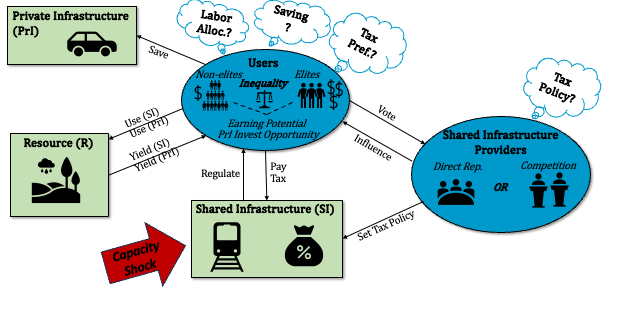
(Wiechman et al, under review)
Project Overview
Within this project, I advance theoretical understanding of shared infrastructure political economies via computational modeling. Despite the tendency of most infrastructure systems work to silo specialities in a particular type (e.g., electricity or public transit), there are common patterns in the political economy (political and economic forces, here, cannot be separated!) of infrastructure investment that deserve higher level study. Public infrastructures are capital-intensive, high-inertia (difficult to alter), necessary for multiple types of economic activity, and responsible for universal public values that often take on the level of *rights* (e.g., one's right to drinking water). Because of this, investment decisions are incredibley complex, subjected to multiple environmental, rule-based, financial, and electoral constraints, but there are similar objectives pertaining to desired levels of fairness, reliability, and quality within uncertain biophysical and sociopolitical contexts.
The central product within this project is a political economic model of shared infrastructure systems (see figure), involving an abstract infrastructure, a resource that requires infrastructure to use, users with varying capacities, and a public infrastructure provider (PIP) responsible for raising revenue (taxes) and investing in infrastructure.
My first manuscript with the model (under review) considers three key factors in public infrastructure systems: (i) the possibility for users to invest in private infrastructure instead of public or shared infrastructure, (ii) the possibility for the PIP to raise taxes only through use of the shared system (e.g., user fees) or to also tax private infrastructure use, and (iii) electoral competition for selecting PIPs. Adding these considerations to an abstract shared infrastructure system, I derive five propositions to ground the political economy of shared infrastructure and orient future empirical studies:
- Inequality, among users, in the ability to invest in private infrastructure decreases shared infrastructure robustness when there is a user fee revenue system.
- Taxing private infrastructure use can increase shared infrastructure robustness if the PIP is insulated from elite capture .
- The effect of equal political representation on shared infrastructure robustness depends on the biases and learning process of voters towards tax policy.
- The length of electoral cycles has a parabolic relationship with shared infrastructure robustness. Increasing electoral cycle length increases robustness up to a point where further increasing the cycle length decreases robustness.
- Increasing the ideological sensitivity of candidates decreases shared infrastructure robustness.