
Archived Projects
Below, I outline projects that I have worked on in the past. I note where the project fits within the research tracks I outline on my About Me page, infrastructure types examined, scope of the case, methods used, questions, relevant publications, and a project overview. Please reach out to me if you would like more information on any of the projects.
Institutional Friction, Flexibility, and Robustness in Infrastructure Systems
- Tracks: Applied Systems Modeling (1), Empirical Investigation (2)
- Infrastructure Type(s): Urban Drinking Water
- Scope: Phoenix Metro Area Cities (AZ) and Indianapolis, IN
- Method(s): Dynamical Systems Modeling, Process Tracing
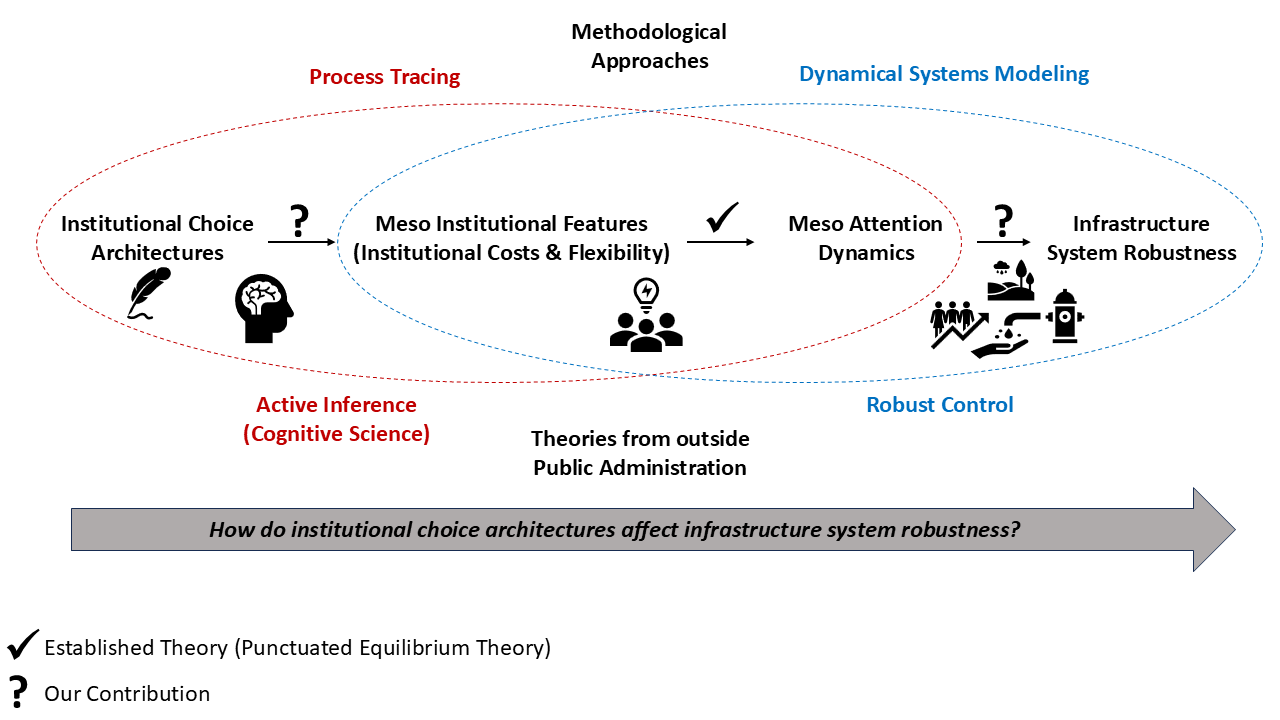
Question(s): How does institutional design affect an infrastructure system’s robustness to environmental changes?
(Wiechman et al, forthcoming)
Project Overview
My doctoral research was motivated by a key gap in how urban water systems are modeled. Despite wide recognition that governance processes affect system response to change, they are rarely included in dynamic models, which can generate misleading findings about resilience. Thus, I developed a dynamical systems model, informed by workshops with Phoenix managers, that uses robust control algorithms to direct investment and ratemaking in urban water systems. I investigated the way institutions can increase costs to act (e.g., veto points) and affect the response of three Phoenix area cities to disruptions in Colorado River supply (Wiechman et al., 2024, Water Resources Research). I found that institutional costs can substantially decrease supply resilience but can benefit user rate burden. I then led a public administration paper (JPART, 2026) to relate the institutional details governing ratemaking to the model’s institutional parameters. We found that when managers are required to address multiple objectives in complex systems, institutional designs benefit from adding flexibility that allows managers to experiment with new approaches.
While I developed the model with the Urban Water Transitions Team, I also worked with a team led by Aaron Deslatte to trace the effect of institutional designs on decision making and response to environmental changes in Phoenix and Indianapolis, IN (see Public Administration, 2025 and International Review of Public Policy, 2023). This established the empirical basis for the modeling work that I am leading in the public administration paper noted above.
Relevant Publications
Journal of Public Administration Research and Theory : "Organizational Strategies for System Robustness: How Managers Navigate the Institutional Architecture of Complex Systems" with Aaron Deslatte, Elizabeth Koebele, Margaret Garcia, and Marty Anderies (2026) linkPublic Administration: "Embracing the ambiguity: Tracing climate response diversity in urban water management. " with Aaron Deslatte (lead) and Elizabeth Koebele (2025) link
Water Resources Research: "Institutional Dynamics Impact the Response of Urban Socio-Hydrologic Systems to Supply Challenges" with Sara Alonso Vicario, Koorosh Azizi, George Hornberger, Margaret Garcia, and Marty Anderies (2024) link
International Review of Public Policy: "Institutions, Voids, and Dependencies: Tracing the Designs and Robustness of Urban Water Systems" with Aaron Deslatte (lead), Elizabeth Koebele, Lauren Bartels, Sara Alonso Vicario, Celeste Coughlin, and Desi Rybolt (2023) link
Collaborative Forum Design and Functionality: Arizona Water User Associations
- Tracks: Empirical Investigation (2)
- Infrastructure Type(s): Water (Urban and Agricultural)
- Scope: Arizona Water User Associations
- Method(s): Surveys, Interviews, Network Analysis
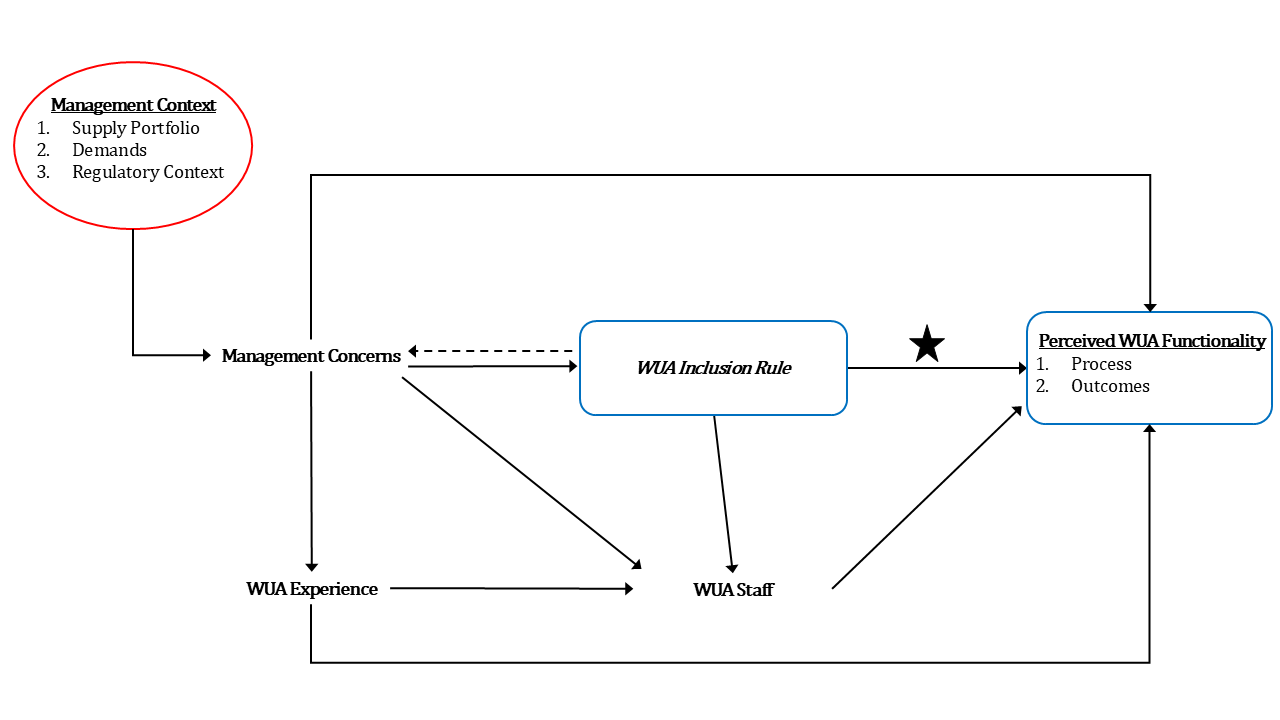
Question(s): How do the inclusion criteria of a collaborative forum relate to participants’ perceptions of forum functionality, given their expressed management concerns? What role do intermediate collaborative forums play in the Phoenix Metro Area municipal surface water governance system? What motivates system actors to participate in intermediate collaborative forums?
(Wiechman et al, 2026)
Project Overview
Infrastructure providers, whether they are cities are regional entities, do not make decisions within their own system silo. There is always collaboration occuring between peers or across jurisdictional levels. While I was in Arizona, I saught to understand the collaborative governance processes at play in drinking water, primarily within the municipal space.
The work consisted of two parts. First, I conducted interviews with managers in the Phoenix Metro Area. I found that forums focusing on a subset of similar actors can create tight coordination and pooling of resources that spills over to other benefits (e.g., lobbying), but may negatively impact actors not included (Wiechman et al., 2023, Journal of Public Administration Research). The second part consisted of a survey to compare multiple forums in Arizona, each with differing levels of inclusion in their membership rules (e.g., one required only public municipal providers with certain water rights while anothing allowed any user that used a certain amount of water). Thus, the central question in the survey work pertained to the trade-off between inclusion and consensus in forum design. I found that members in less inclusive forums benefit from capacities that require tight coordination (e.g., lobbying) while those in more inclusive forums are more likely to perceive their region as cooperative (under review). As environmental issues continue to cross jurisdictions, this work informs the design of needed collaborative forums.
Relevant Publications
Policy Studies Journal: "The Inclusion Trade-off: Comparing the Design and Functionality of Collaborative Governance Forums" with Elizabeth Koebele, Margaret Garcia, and Marty Anderies (2026) linkJournal of Public Administration Research and Theory: "The Role of Intermediate Collaborative Forums in Polycentric Environmental Governance" with Sara Alonso Vicario and Elizabeth Koebele (2023) link